

What Is Demand Response—and How Can Your Business Get Paid?
You’ve just closed up for the night. The last employee has clocked out, the fryer is off, and the dining room is dark.
But somewhere in the building, the HVAC is still running, the refrigeration units are humming, and the meter is still spinning.
That same building consuming energy after hours could be generating revenue instead.
Thousands of commercial operators across Texas are already doing it, and the program that makes it possible is simpler, more accessible, and more profitable than most business owners expect.
What Is Demand Response?
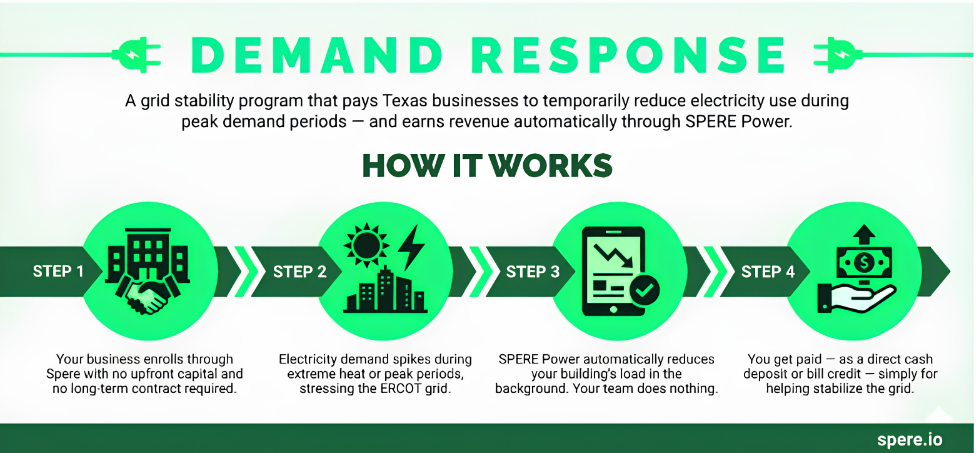
Demand response is a program that pays businesses to temporarily reduce electricity usage when the grid is under stress. During peak periods, utilities ask participating buildings to lower consumption for short windows in exchange for compensation.
In simple terms, your building earns by using slightly less power when electricity demand is highest. These adjustments are small, often unnoticeable, but they help prevent outages and reduce strain on the grid.
The electrical grid is always on, requiring supply and demand to match in real time. When demand spikes too quickly, demand response gives the grid the flexibility it needs while turning your energy use into a new revenue stream.
Before energy demand management tools existed, participating in these programs required manual intervention—someone had to actively monitor alerts and make adjustments on the fly. Today, software handles it automatically, adjusting loads in the background while your business runs normally.
Businesses that participate typically reduce usage through:
- Adjusting thermostat setpoints by a few degrees
- Dimming non-essential lighting
- Temporarily cycling down certain equipment
The core idea is straightforward: the grid needs a little breathing room, and your business gets compensated for providing it.
How a Demand Response Event Works
Some business owners hear “demand response” and picture a daily disruption—lights flickering, equipment shutting down, customers complaining. That concern is understandable, but the reality looks very different.
Take a busy lunch rush at a QSR franchise in Houston. The kitchen is running at full capacity, the dining room is packed, and the last thing any operator needs is an interruption. A demand response event, however, isn’t timed to your busiest moments. On ERCOT’s grid, emergency demand response events occur just 0–2 times per year, each lasting under an hour. Your business participates in load shedding far less often than most operators expect.
When an event does occur, Spere’s software handles it automatically. For energy management for restaurants specifically, this typically means nudging HVAC setpoints up by a degree or two during the event window, an adjustment so minor that customers rarely notice. The same predictive maintenance intelligence that monitors your HVAC for early warning signs also ensures equipment isn’t stressed during these brief curtailment periods.
Participation in a demand response program, it turns out, asks very little of your business while returning something meaningful in exchange.
How Demand Response Payments Are Calculated
Think of demand response like a volunteer fire brigade. The town pays its volunteers a retainer simply for being available and ready to respond, and when a fire actually breaks out, they earn additional compensation for showing up.
Your building works the same way. Enrollment in a demand response program means you’re on standby for the grid, and that availability itself generates energy incentives for businesses before a single event ever occurs.
How much can you actually earn? It depends on which program tier you’re enrolled in. At the retail utility level, payments typically come as bill credits tied to real-time pricing adjustments during peak periods. At the wholesale ERCOT level, the numbers get more interesting:
- Load Resource participants in ERCOT’s Responsive Reserve Service earn approximately $100,000 per MW per year
- A single QSR location isn’t a megawatt on its own, but Spere aggregates multiple locations into a combined load resource
- For an operator with 10 locations shedding a combined 200 kW, that translates to roughly $20,000 in annual cash payments
Your buildings quietly earn while your team focuses on running the business.
How to Get Started with Demand Response Through Spere
For most operators, the biggest barrier to demand response isn’t the technology—it’s not knowing where to begin. Spere removes that barrier entirely.
Enrollment starts with a detailed energy analysis of your current usage and a documented savings projection based on your actual utility data.
For buildings without existing control systems, Spere installs the necessary hardware with no upfront capital required. From there, SPERE Power handles participation automatically, responding to grid signals in the background while your team stays focused on running the business.
There are no long-term contracts, no surprise fees, and no technical expertise required on your end.
Mitch Cook, Spere’s CEO, has seen this moment hundreds of times: “The operators who benefit most from demand response are the ones who never have to think about it. That’s exactly what we built Spere to do: make it invisible, make it automatic, and make sure the money shows up.”
Enrollment is open now. One conversation with Spere is all it takes to find out exactly what your buildings could be earning.
See What Your Buildings Could Be Earning
Demand response isn’t complicated. It’s a revenue stream your buildings are already capable of generating, and the right platform makes all the difference. Find out what your locations could be earning. Schedule a free energy analysis with Spere today.
FAQ Schema Markup
How does a demand response event work?
A demand response event is triggered when a grid operator like ERCOT detects that electricity demand is outpacing supply. Participating businesses receive a signal to temporarily reduce their electricity consumption.
This typically involves small adjustments like raising thermostat setpoints by a degree or two or dimming non-essential lighting—changes so minor that customers and staff rarely notice any difference.
How do businesses get paid for demand response?
Payment depends on which program tier a business is enrolled in.
At the retail utility level, businesses typically receive bill credits. At the wholesale ERCOT level, businesses enrolled as Load Resources earn availability payments simply for being on standby, plus additional compensation when an event actually occurs.
Historically, Load Resource participants in ERCOT’s Responsive Reserve Service have earned approximately $100,000 per MW per year.
How does Spere handle demand response automatically?
SPERE Power’s automated demand response capability monitors your buildings in real time and responds to grid signals without any manual intervention required.
When an event is triggered, the platform makes pre-approved adjustments to your building’s systems automatically. Your team never needs to monitor alerts, track utility signals, or make adjustments on the fly.
How often do demand response events happen?
Less often than most business owners expect. On ERCOT’s grid, emergency demand response events occur just 0–2 times per year, each lasting under an hour. Availability payments, however, are ongoing—meaning your business earns simply for being enrolled and ready, regardless of whether an event occurs.
Can I opt out of a demand response event if my business needs full power?
Yes. SPERE Power gives operators full opt-out control via the app for critical moments like health inspections or peak service periods. Spere’s platform is designed to work around your operational needs, not disrupt them.